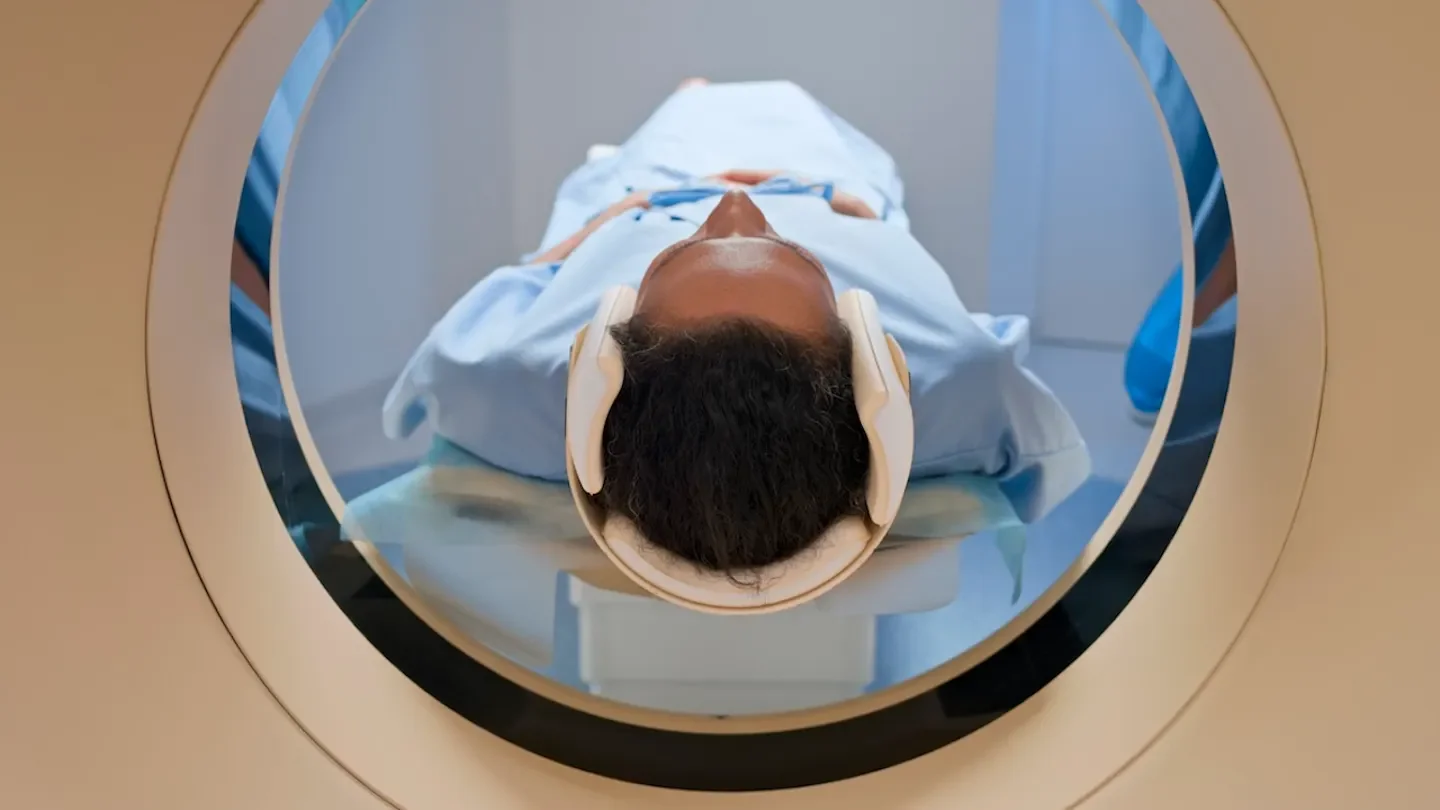
MRI may form part of a specialist assessment for trigeminal neuralgia. Contextual scanner photograph, not a diagnostic image or a recommendation that everyone with facial pain needs a scan.
Trigeminal neuralgia can cause brief, severe attacks of facial pain that feel like an electric shock. The pain may be triggered by a light touch, brushing teeth, eating, talking or a cool breeze. It often affects one side of the face, particularly the cheek or jaw. That pattern is important, but it is not enough to diagnose the condition without considering other causes.
Repeated facial pain deserves a clear assessment rather than repeated courses of ordinary painkillers or an assumption that every attack comes from a tooth. Dental problems, jaw disorders and other neurological conditions can overlap. The aim is to identify the pain pattern, check for warning signs and arrange treatment that fits the diagnosis.
What does trigeminal neuralgia feel like?
The characteristic attacks are sudden, severe and short-lived, lasting from a few seconds to about two minutes. They may stop as abruptly as they start. Some people have long pain-free intervals; others experience repeated attacks through the day. A continuous ache or burning pain may occur alongside the sharp attacks, although a different or changing pattern needs review.
The trigeminal nerve carries sensation from the face, mouth and teeth to the brain. Its branches cover the forehead and eye region, cheek and upper jaw, and lower jaw. Pain commonly affects the cheek or jaw on one side. Facial weakness is not the defining feature of trigeminal neuralgia and should not simply be attributed to it.
Why can a light touch cause such severe pain?
Ordinary activities can trigger a burst of nerve pain. Washing, shaving, applying make-up, brushing teeth, chewing or talking may become difficult. Wind or air conditioning can also provoke attacks. Sometimes there is no obvious trigger. The severity is not a reflection of how much force was applied to the face.
Avoiding every trigger is rarely a workable long-term plan. When fear of pain starts to limit eating, drinking, oral care or conversation, that effect deserves attention in the treatment plan. A quieter period does not mean the earlier pain was unimportant, and a normal appearance between attacks does not rule out a significant problem.
Is the pain coming from a tooth or a nerve?
Pain felt in the teeth or gums often leads people to see a dentist first. That is appropriate when dental disease is possible. A dentist can look for infection, a cracked tooth and other local causes, using an examination and dental imaging where needed. Trigeminal neuralgia and dental disease should not be treated as interchangeable labels.
If a dentist cannot identify a dental explanation, a GP assessment is a sensible next step. Repeated dental treatment without a clear dental cause may not address nerve pain. Equally, swelling, fever, a bad taste, persistent toothache or sensitivity should not be dismissed as neuralgia simply because a previous attack felt electrical. A suspected dental abscess needs urgent dental care.
What causes trigeminal neuralgia?
The condition is often associated with a blood vessel pressing on the trigeminal nerve close to the brain stem. Other conditions, including multiple sclerosis or a growth affecting the nerve, can also cause trigeminal neuralgia. In some people an underlying cause is not identified. A description of the pain cannot establish which explanation applies.
The possibility of an underlying condition is a reason for a measured assessment, not an assumption that a serious cause is likely. Age, examination findings, symptoms between attacks and the response to treatment all help decide whether specialist investigation is needed. Trigeminal neuralgia is uncommon in younger adults, which makes careful review particularly important when it occurs at a young age.
What happens during a GP assessment?
The history is central. A clinician considers exactly where the pain occurs, how long each attack lasts, how often it happens, what triggers it and whether there is pain between attacks. Previous dental assessment, rashes, injuries, operations and neurological symptoms may be relevant. Current medicines and their effects also matter.
An examination may assess the face, mouth, jaw and nervous system. A diagnosis is not made from one blood test, and there is no single simple test that confirms every case. The consultation should distinguish a recognisable neuralgia pattern from pain that requires a different route, while taking its effect on sleep, food intake, work and mood seriously.
When is an MRI scan useful?
MRI can help investigate possible causes of facial pain and assess the relationship between blood vessels and the trigeminal nerve. It may identify another condition affecting the nerve. A scan is part of the diagnostic picture, not a substitute for a careful history and examination.
NICE Clinical Knowledge Summaries advises specialist MRI assessment in situations such as younger age, atypical symptoms, failure to respond to initial treatment or consideration of neurosurgery. Persistent numbness or other abnormal neurological findings also merit particular attention. Not everyone with facial pain needs an immediate scan, and not every scan finding explains the symptoms.
Why do ordinary painkillers often disappoint?
Trigeminal neuralgia is a type of nerve pain. Paracetamol and similar standard painkillers are often ineffective for the characteristic attacks. Increasing doses beyond the instructions is unsafe and does not turn them into effective treatment for neuralgia. A different prescribing approach is usually needed once the diagnosis is considered.
Carbamazepine is the first medicine usually recommended in UK guidance. Although it is also used for epilepsy, its use here is to reduce nerve-pain signalling. Being offered it does not mean a clinician thinks the person has epilepsy. It requires an individual prescription and review rather than self-treatment with someone else's medicine.
How is carbamazepine treatment reviewed?
Treatment is generally started at a low dose and increased gradually according to a clinician's plan. It is taken regularly rather than only at the instant an attack occurs. The dose, formulation, interactions and monitoring need to reflect the individual. This article is not a dosing guide, and prescribed treatment should not be changed abruptly without advice.
Early follow-up checks both benefit and tolerability. Dizziness, sleepiness, unsteadiness and other side effects can affect everyday safety. Existing medicines, pregnancy or plans for pregnancy, and any troublesome symptoms should be discussed with the prescriber. A severe rash with blisters or ulcers requires emergency assessment. Call 999 or go to A&E rather than waiting for a routine review.
What if medicine does not control the pain?
NICE guidance supports specialist advice when carbamazepine is unsuitable, ineffective or not tolerated. Alternative medicines should be chosen with specialist input rather than tried as an unsupervised sequence. A review should also reconsider the diagnosis when treatment fails, particularly if the symptom pattern has changed.
Severe pain or a major effect on daily activities can justify referral at any stage. Specialist options may include other medicines, pain-service support or procedures. The decision should consider pain relief, side effects, general health and the person's priorities. There is no single procedure that is right for every client.
Does everyone eventually need surgery?
No. Many people receive medical treatment, with review as symptoms fluctuate. When medicine cannot provide acceptable control, procedures can be discussed. Some aim to interrupt pain signals by treating the nerve; microvascular decompression aims to move a compressing blood vessel away from it.
These approaches have different benefits, risks and recovery demands. Facial numbness and other complications need to be understood, and microvascular decompression is major surgery. A specialist should explain likely benefit and uncertainty for the particular situation. An online article cannot predict a personal surgical outcome or promise permanent relief.
Which symptoms need urgent help?
Call 999 for sudden facial drooping with arm weakness or speech difficulty, even if symptoms improve. These can be signs of a stroke, not a routine neuralgia flare. Dental or facial swelling that makes breathing, speaking or swallowing difficult also needs emergency care. Do not drive yourself to A&E.
A new severe headache with scalp or temple tenderness, jaw pain while eating or visual symptoms needs urgent GP or NHS 111 assessment because temporal arteritis is one possible cause. Vision problems in that setting need same-day specialist assessment. Persistent facial numbness, new neurological symptoms or a substantially different pain pattern also require prompt clinical review.
Keeping eating, sleep and daily life in view
The burden of trigeminal neuralgia is more than the number of attacks. Pain can make meals and basic oral care difficult, disturb sleep and lead to isolation or low mood. A review should consider these effects alongside the medicine dose. Difficulty maintaining food or fluid intake warrants prompt advice rather than waiting for a scheduled follow-up.
A brief record of attacks, triggers, medicine use and side effects can help the treating clinician see whether the plan is working. There is no need to provoke pain to demonstrate it. For clients arranging an online consultation, previous dental findings and a current medicine list can help make the discussion more focused. An in-person examination or specialist assessment may still be needed.
Discuss a non-urgent facial-pain assessment.
Frequently asked questions
Can trigeminal neuralgia feel like toothache?
Yes. Pain may be felt in the jaw, teeth or gums, which is why dental assessment is often part of the pathway. If no dental cause is found, a GP can assess a possible nerve-pain pattern. New swelling or signs of infection still need dental attention, even if neuralgia has been diagnosed before.
Does a normal examination between attacks rule it out?
No. The history of short, severe, triggered attacks is important, and someone may look well between episodes. The clinician still needs to consider other explanations and any abnormal findings. A normal interval does not make the pain imaginary or remove the need for assessment.
Is trigeminal neuralgia the same as Bell's palsy?
No. Trigeminal neuralgia mainly describes a characteristic pain syndrome, not facial weakness. A new facial droop needs urgent assessment, particularly with arm weakness or speech changes. Do not use an existing facial-pain diagnosis to explain away a new neurological symptom.
Can I take treatment only when an attack starts?
The medicines used to prevent neuralgia attacks are generally taken regularly according to the prescription. They are not simply rescue painkillers for a seconds-long episode. Follow the agreed plan and speak to the prescriber about poor control or side effects rather than increasing, skipping or stopping doses yourself.
What happens if the pain disappears for a while?
Periods of remission can occur. Any reduction in prescribed medicine should be planned with the clinician and usually needs to be gradual. A pain-free period is useful information for review, but it is not a reason to stop treatment abruptly or assume the condition cannot recur.
Can an online GP confirm the diagnosis?
Remote consultation can help clarify the pattern, review previous dental findings and plan the next step. It cannot replace every aspect of a face, mouth or neurological examination. Where the diagnosis is uncertain, warning signs are present or treatment needs specialist input, an appropriate in-person or specialist route is needed.
Sources
NHS, Trigeminal neuralgia overview
NHS, Trigeminal neuralgia diagnosis
NHS, Trigeminal neuralgia treatment