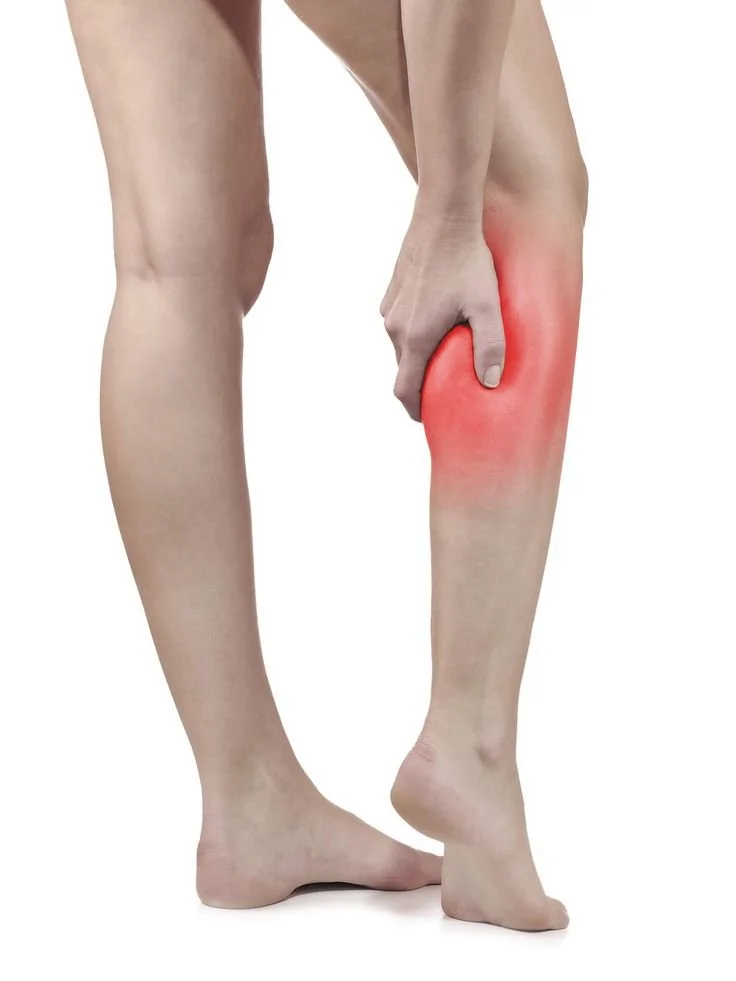
Recurring calf pain during walking can have several causes and needs assessment. Illustrative photograph with a pain highlight, not an image that diagnoses arterial disease.
Calf pain that starts during a walk and settles after a few minutes of rest can be a sign of intermittent claudication. This is a symptom of reduced arterial blood supply to the leg. It can feel like cramp, aching, burning or an unusual tiredness in the muscles, and it deserves assessment rather than being dismissed as age or poor fitness.
The pattern is not a diagnosis on its own. Muscles, joints, nerves and blood vessels can all contribute to leg symptoms. A clinical assessment establishes whether circulation is involved, whether anything needs urgent attention and what treatment is appropriate. Sudden severe pain with a cold, pale or numb foot is different from a familiar walking ache and needs emergency care.
When does leg pain need emergency attention?
Acute limb ischaemia means a sudden, serious reduction in blood flow to a limb. Warning features include sudden persistent pain, a cold foot or leg, pallor or a mottled appearance, new numbness and loss of power. NHS vascular referral guidance treats this as an emergency requiring immediate hospital assessment. Call 999 or go to A&E immediately if this pattern develops.
Do not wait to find every possible sign or try to locate your own foot pulse before seeking help. A limb that becomes suddenly cold and weak should not be managed by walking it off, massage or an online enquiry. An existing diagnosis of poor circulation does not make a sudden deterioration routine.
A blood clot in a vein is a different problem. The NHS advises an urgent GP appointment or NHS 111 for suspected DVT, which can cause one-sided leg pain and swelling. Pain and swelling with breathlessness or chest pain need 999 or A&E. Do not drive yourself to A&E in that situation.
Which changes need prompt clinical review?
Pain in the foot or toes at rest, especially pain that disturbs sleep, needs review rather than an assumption that it is ordinary cramp. A non-healing wound, tissue damage or a marked change in the foot can indicate a more serious circulation problem. Seek prompt medical advice so the urgency of vascular assessment can be established.
Chronic limb-threatening ischaemia is the term used for serious ongoing impairment of blood supply associated with rest pain or tissue loss. It is not the same as uncomplicated intermittent claudication. People with diabetes and reduced sensation may have a significant wound without much pain, so comfort alone is not reassuring.
A wound with severe infection or general illness can require emergency care. A previously stable walking pattern also needs reassessment if it changes suddenly or in clear steps. The useful question is not only how far someone can walk, but whether the symptoms, foot condition or function are changing.
What is intermittent claudication?
Leg muscles need more oxygen when they work. When narrowed arteries cannot supply enough blood to meet that demand, walking can produce pain or cramping. Stopping reduces the muscles' demand, and the discomfort often eases after a few minutes. The NHS identifies this walking-and-rest pattern as a main symptom of peripheral arterial disease, often shortened to PAD.
The calves are a common site, but symptoms can also occur in the thighs or buttocks. Both legs may be affected, sometimes unevenly. Some people notice a fairly predictable walking distance, with symptoms coming on earlier on a hill. Others describe weakness or tiredness rather than using the word pain.
That pattern is useful clinical information, but it cannot establish which artery is involved or how severe the problem is. Nor does the absence of a textbook description rule out PAD. Some people have arterial disease without obvious symptoms, particularly when another condition already limits how much they walk.
Why is PAD about more than the legs?
PAD is usually caused by a build-up of fatty deposits in arteries, called atherosclerosis. The effect on walking may be the first noticeable problem, but the diagnosis also signals increased cardiovascular risk. The NHS notes a higher risk of heart attack and stroke. Treatment therefore addresses both leg symptoms and wider vascular health.
Smoking, diabetes, high blood pressure and abnormal cholesterol are important parts of the assessment. These factors do not prove the cause of a particular calf ache, and someone should not be excluded from assessment because they do not match a stereotype. They help the clinician decide what to investigate and which risks can be changed.
Improving walking distance is a useful goal, but it is not the only measure of care. Blood pressure management, appropriate medicines, smoking support and diabetes care may matter even if the calf discomfort becomes less troublesome. A quieter symptom does not necessarily mean the underlying cardiovascular risk has disappeared.
How is circulation pain distinguished from other causes?
The history considers exactly where the pain is, what brings it on, how quickly it settles and whether position makes a difference. Back-related nerve symptoms, joint disease and muscle or tendon problems can overlap with circulation symptoms. More than one cause can be present, especially when someone has several long-term conditions.
A local injury may have a different relationship to movement or load. A neurological problem can bring altered sensation or weakness. A new swollen leg raises a different set of concerns from a stable exertional ache. These distinctions guide assessment; they are not a reliable home checklist for excluding a vascular problem.
It is sensible to describe the pattern in ordinary terms. The distance to a familiar landmark, whether a hill changes it and how long the stop lasts can be useful. The clinician can then decide whether a vascular, neurological or musculoskeletal route best fits, rather than selecting treatment from the location of pain alone.
What happens during a GP assessment?
An assessment includes the symptoms and their effect on daily life, relevant medical history, current medicines and cardiovascular risk factors. The clinician examines the legs and feet, including skin changes, wounds and pulses. NICE recommends considering both intermittent claudication and signs of more serious impairment of circulation.
The examination is not simply a check that the foot looks normal. Skin colour and temperature, tissue condition and the symptom history all contribute. A person with diabetes may have both nerve and circulation problems. A single reassuring feature should not overrule a concerning overall pattern.
Existing vascular reports and a current medicine list can help avoid unnecessary repetition. The assessment should also establish what needs to happen if symptoms worsen before the next appointment. A routine investigation plan is not a reason to wait if the foot becomes suddenly cold, numb or weak.
What is an ankle brachial pressure index?
The ankle brachial pressure index, or ABPI, compares blood pressure measurements at the ankle and arm. It helps assess arterial blood supply to the legs. NICE describes measurement with appropriate cuffs and a Doppler probe, interpreted alongside the examination and symptoms. It is not the same as checking a finger oxygen reading.
A reduced result can support a diagnosis of PAD. The meaning of a normal or high result needs care, especially in diabetes. NICE specifically says not to exclude PAD in someone with diabetes based only on a normal or raised ABPI. Hardening of the arteries can affect the measurement.
This is why a number obtained in isolation should not be treated as a complete answer. Persisting symptoms, wounds or a concerning examination may require further assessment despite a reassuring-looking result. The question is whether the test adequately explains the clinical picture, not simply whether it falls inside a printed reference range.
Are scans or blood tests always necessary?
Blood tests can help assess associated risks and conditions, such as glucose control, cholesterol or other relevant health factors. They do not directly show whether a particular leg artery is narrowed. Their purpose should be explained so a general blood panel is not mistaken for a complete circulation assessment.
Further vascular testing may be considered when resting measurements do not settle the diagnosis. A specialist service may assess the response to exercise or use other pressure measurements. Local NHS pathways describe different arrangements, and these should not be read as a promise that every clinic offers the same tests on site.
NICE recommends duplex ultrasound as first-line imaging when a procedure to improve blood flow is being considered. Further angiographic imaging may then be appropriate. That does not mean every person with a walking ache needs an immediate MRI or CT scan. Imaging should answer a defined question and inform a treatment decision.
Why is exercise part of treatment?
For established intermittent claudication, structured exercise is an important treatment rather than evidence that the symptoms are imaginary. NICE recommends a supervised exercise programme. A planned programme can help improve walking ability, with the activity, progression and rest periods adapted to the person's clinical situation.
Different guidance describes exercise intensity in different words. NICE discusses exercising to maximal pain within a supervised programme, while a current NHS regional pathway describes walking to discomfort, resting until it settles and repeating. Neither should be turned into a blanket instruction to push through any new or unexplained leg pain.
The diagnosis and safety assessment come first. Rest pain, wounds, a sudden deterioration or other health limitations can change the advice. A clinician can explain how the programme should feel, when to rest and which symptoms mean stopping and seeking help. Access to a particular programme also needs confirmation rather than assumption.
Which medicines may be considered?
Medicines can address cardiovascular risk and, in selected circumstances, walking symptoms. NICE includes antiplatelet treatment and lipid management within the care of PAD, alongside attention to diabetes and blood pressure. The appropriate choice depends on the person's other conditions, bleeding risk, current treatment and clinical assessment.
Not every medicine described as a blood thinner has the same role. Antiplatelet drugs and anticoagulants work differently and are not interchangeable home remedies. Do not start aspirin, borrow another person's medicine or stop a prescribed treatment because of an article. A clinician should review the intended benefit and the risks.
Some medicines for claudication are considered only when exercise has not helped enough and other options have been discussed. The aim, review date and criteria for continuing should be clear. A prescription is one part of management, not a substitute for reassessing a new wound or a change in circulation symptoms.
When is a vascular specialist needed?
An urgent vascular route is important when rest pain, tissue loss or another limb-threatening feature is suspected. For more stable intermittent claudication, referral depends on diagnostic uncertainty, functional impact and response to appropriate treatment. A person who cannot manage ordinary daily activities may need a different discussion from someone with mild, stable symptoms.
Referral does not automatically lead to an operation. NICE places supervised exercise and cardiovascular risk management before angioplasty for many people with intermittent claudication. Angioplasty, stenting or bypass may be considered in selected circumstances after imaging and discussion of likely benefit, risks and alternatives.
The balance is different when blood supply threatens the limb. Treatment decisions then require specialist assessment rather than simply extending a routine walking programme. The purpose of referral is to reach the right decision for the clinical situation, not to promise that a particular procedure will be offered or will restore a previous walking distance.
How should feet be protected?
PAD can make foot problems more important, particularly when diabetes or reduced sensation is also present. The NHS advises looking after the feet and keeping blood glucose controlled in diabetes. A wound that is not healing should be assessed rather than covered indefinitely while waiting for it to become painful.
Skin changes are worth reporting in context. Shiny skin, colour change, altered temperature and changes in hair or nails can occur, but none alone establishes the diagnosis. A new injury or ulcer needs attention even if a previous circulation assessment was reassuring. The current condition of the foot matters.
Avoid treating an undiagnosed circulation concern with strong compression simply because the leg feels uncomfortable. NICE includes people being considered for compression hosiery among those who should be assessed for PAD. Whether compression is appropriate depends on the clinical situation, not on assuming all leg symptoms are caused by the same type of circulation problem.
What does a useful follow-up review cover?
A review can compare walking ability with a familiar baseline, while also checking pain at rest, foot condition and any new neurological symptoms. It should consider how the treatment plan fits work, mobility and other health conditions. A small improvement in one area should not hide a concerning change elsewhere.
Medicines and cardiovascular risks need follow-up too. Difficulties with treatment, side effects or barriers to exercise are reasons to adjust the plan with the clinician, not to quietly abandon it. Support for stopping smoking can be part of medical care rather than an instruction left for someone to manage alone.
The plan should make the next step clear if symptoms remain limiting or the diagnosis is uncertain. It should also separate routine follow-up from urgent reassessment. Sudden coldness, numbness or weakness is not something to save for a planned review, and a non-healing wound deserves attention before the walking distance is measured again.
Discussing walking-related calf pain with The Online GP
For a non-emergency concern, The Online GP by The Wellness can receive an enquiry about assessment of recurring calf pain during walking. Describe the walking-and-rest pattern, whether symptoms are changing, any foot wound or rest pain, and relevant history such as diabetes or previous vascular treatment.
An enquiry does not confirm an on-site ABPI, scan, vascular procedure or appointment timescale. The clinical assessment determines the appropriate next step, which may involve another service. Emergency symptoms need emergency care rather than a routine message, and possible limb-threatening changes should not be delayed while arranging a private consultation.
Discuss non-emergency walking-related calf pain and assessment with The Wellness
Frequently asked questions
Is calf pain that stops with rest always poor circulation?
No. It is a pattern that can suggest intermittent claudication, but it does not prove the cause. Nerves, muscles and joints may also contribute. An assessment considers the history, examination and appropriate circulation tests rather than making the diagnosis from pain location alone.
Can I have PAD with a normal ankle pressure result?
Yes. NICE warns against excluding PAD in someone with diabetes solely because ABPI is normal or raised. The result needs to be interpreted with symptoms and examination. Persistent symptoms or a concerning foot problem may justify further vascular assessment rather than reassurance from one number.
Is a swollen painful calf the same as claudication?
No. One-sided pain and swelling can suggest DVT and need an urgent GP appointment or NHS 111. If those symptoms occur with breathlessness or chest pain, call 999 or go to A&E. Do not assume a new swollen leg is a familiar circulation ache.
Should I force myself to walk through new pain?
No. Structured exercise can help confirmed intermittent claudication, but the diagnosis and safety assessment come first. A clinician should explain the appropriate intensity and rest periods. Sudden severe pain, a cold or numb foot, rest pain or wounds need assessment rather than an unsupervised challenge.
Does a vascular referral mean I need surgery?
No. Many people with stable claudication are managed with exercise, medicines and cardiovascular risk reduction. A specialist may clarify the diagnosis or discuss options without recommending a procedure. More serious impairment of blood supply requires a different and more urgent assessment.
When should I go straight to emergency care?
A suddenly painful, cold, pale or mottled limb with numbness or weakness can indicate acute limb ischaemia and needs immediate hospital assessment. Call 999 or go to A&E. Do not wait for all the signs to appear or delay care for a routine online enquiry.
Sources
NHS, Peripheral arterial disease
NICE, Peripheral arterial disease: diagnosis and management
Leeds Teaching Hospitals NHS Trust, Intermittent claudication
NHS BNSSG Remedy, Peripheral arterial disease