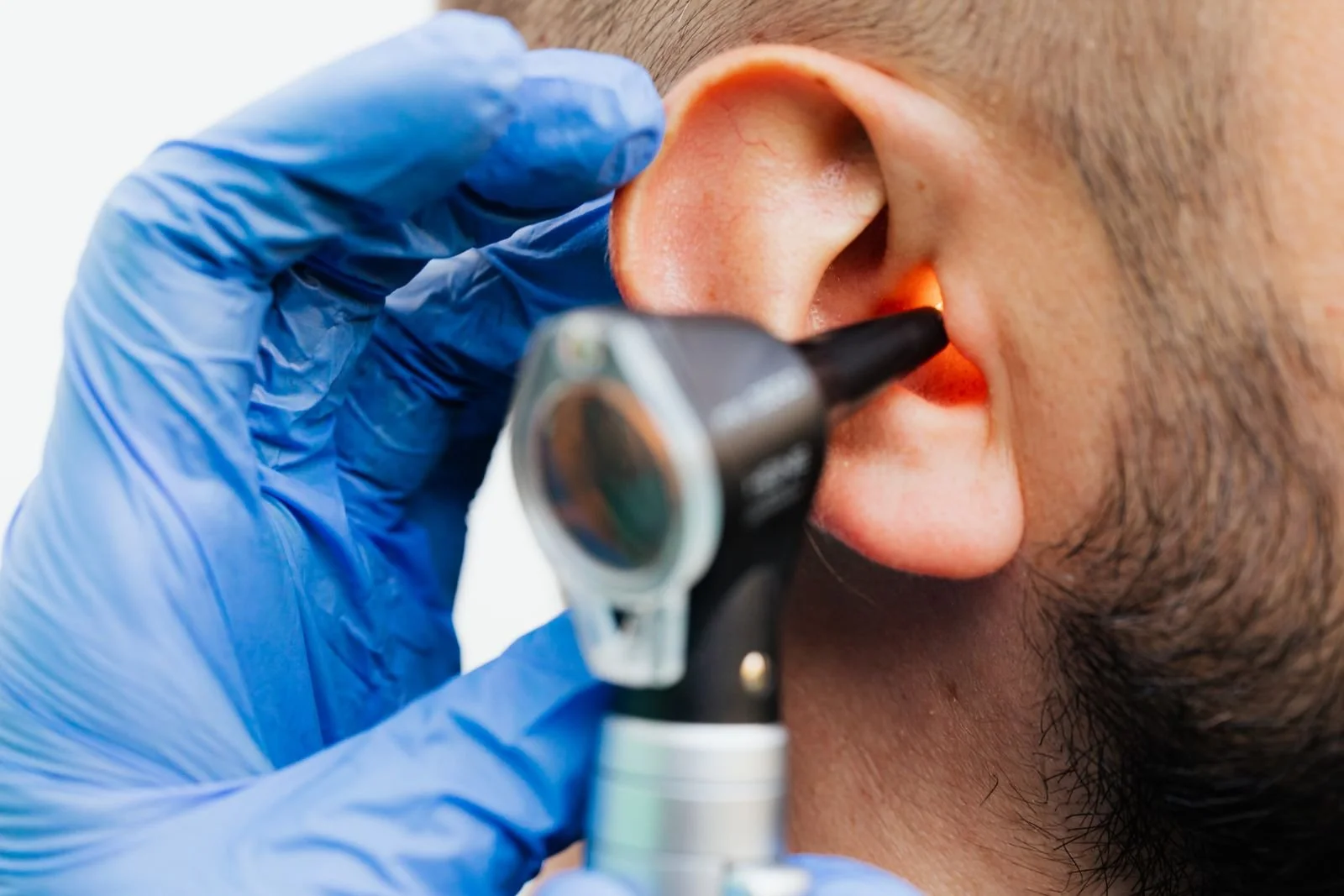
An ear examination is one part of assessing pulsatile tinnitus. A normal-looking ear does not remove the need for hearing assessment and appropriate investigations. Illustrative photograph.
Hearing a repeated whoosh or throb in time with the heartbeat is different from the more familiar ringing form of tinnitus. It is called pulsatile tinnitus. The sound may be in one ear, both ears or the head, and it can come and go. Its rhythm is useful information, but it does not identify the cause by itself.
The NHS advises an urgent GP appointment for tinnitus that beats in time with the pulse. This is not a symptom to put down to stress or earwax without assessment. Tinnitus after a head injury, or with sudden hearing loss, facial weakness or vertigo, needs A&E or 999 rather than an elective clinic booking. Understanding that distinction allows the assessment to begin in the right place.
What makes tinnitus pulsatile?
Tinnitus means hearing a sound without an outside source. The sound can be described as ringing, buzzing, humming, hissing or whooshing. With pulse-synchronous tinnitus, the rhythm follows the heartbeat. That is more informative than whether the sound seems loud, faint, high or low pitched.
Pulsatile tinnitus can reflect a change in blood flow near the ear or a change in how readily that flow is heard. It does not follow that everyone with the symptom has a dangerous blood-vessel condition. Equally, the fact that a sound is intermittent or more noticeable at bedtime does not establish that it is harmless. The history, examination and appropriate investigations are considered together.
The term is sometimes used loosely for any rhythmic sound. A clicking or fluttering that does not follow the pulse may have a different explanation, including muscle activity around the ear or palate. Describing the rhythm accurately helps the clinician decide which questions and examinations matter.
Why can it be louder in a quiet room?
Quiet surroundings can make internal sounds more noticeable because there is less competing sound from the environment. This can explain why someone first becomes aware of a whoosh when lying in bed, concentrating at a desk or trying to sleep. Awareness at these times is not a diagnosis of its cause.
Hearing changes can also alter how clearly internal sounds are perceived. A problem affecting the passage of sound through the outer or middle ear may increase awareness of sounds within the body. Wax, middle-ear fluid and other ear conditions therefore remain part of the examination. However, finding a blocked sensation does not remove the need to describe the heartbeat relationship and any associated symptoms.
Support with sleep and concentration can be useful while assessment proceeds. It should sit alongside the investigation of a pulse-synchronous sound, not replace it with a general tinnitus explanation.
What causes are considered?
There are several possible mechanisms rather than one universal cause. Blood flow may be increased throughout the body, as can occur with significant anaemia or an overactive thyroid. There may instead be a change involving a blood vessel near the ear. Some ear conditions make ordinary blood flow more audible even without an abnormal increase in flow.
The wider assessment also considers the cardiovascular examination, the ear examination and associated neurological symptoms. Certain structural conditions in the head and neck, and disorders involving raised pressure around the brain, can produce pulsatile tinnitus. Headache and visual disturbance are relevant information in that context. A list of possible causes cannot tell an individual client which one applies.
The purpose of assessment is to narrow these possibilities in a sensible sequence. It is not to assume the rarest explanation, nor to rule everything out with an untargeted collection of tests. Normal findings at one stage help guide the next stage, but do not automatically answer every question.
What does the first consultation establish?
The clinician considers when the sound began, whether it is constant or intermittent, which side is affected and whether it follows the heartbeat. Hearing loss, ear pain, discharge, dizziness, headache, visual symptoms and any recent head injury can change the appropriate route and urgency. Previous ear problems, relevant medical conditions and current medicines provide further context.
The effect on daily life matters too. Difficulty sleeping, reduced concentration or distress deserve attention even while the cause is being investigated. NICE recommends discussing the impact of tinnitus and agreeing a plan that reflects the person's needs, rather than treating the sound as an isolated test result.
A careful consultation separates what is known from what still needs examination. A description of a pulse-synchronous sound may be enough to identify that further assessment is needed. It is not usually enough to confirm why the sound is happening or to choose the complete investigation pathway remotely.
Why does an in-person examination matter?
Looking in the ears can identify wax, infection, a middle-ear problem or another visible abnormality. The clinician may also assess hearing, blood pressure, the cardiovascular system and the neck. Depending on the presentation, a neurological examination or assessment of other associated symptoms may be relevant.
A stethoscope may be used to listen for a sound around the neck or skull. When the clinician can hear a corresponding noise, it is described as objective tinnitus. When only the person experiencing it can hear it, it is subjective. The latter does not mean that the symptom is imagined or that no physical cause can be found.
These examinations cannot be reproduced fully by a video call. An online consultation may help establish the history and the appropriate next step, but it should not be presented as a substitute for otoscopy, listening to blood flow or a formal hearing assessment. The format of care needs to follow the clinical question.
What can a hearing assessment contribute?
NICE recommends an audiological assessment for people with tinnitus. It can establish whether hearing loss is present and help describe its pattern. That matters because an ear-related reduction in the transmission of sound can affect awareness of internal noise, while other hearing findings may influence referral and imaging decisions.
Tympanometry may be considered when middle-ear or Eustachian tube dysfunction, or another cause of conductive hearing loss, is suspected. It addresses a different question from a scan of the head or neck. There is no single hearing test that identifies every cause of a heartbeat sound.
The results are interpreted with the examination and the history. A normal hearing assessment is useful information, but NICE still recommends imaging for pulsatile tinnitus. Normal hearing should therefore not be used on its own to close the assessment of an otherwise unexplained pulse-synchronous sound.
When are blood tests useful?
Blood tests may be selected when the history and examination suggest a contributor such as anaemia or an overactive thyroid. A full blood count and thyroid function tests answer particular questions. They are not a universal explanation for tinnitus and should not be promoted as a complete tinnitus screen.
If a result is abnormal, its relationship to the symptoms needs clinical interpretation. Finding a relevant condition can change treatment, but it does not automatically make other findings irrelevant. Similarly, normal blood tests do not exclude all ear, vascular or structural causes of pulsatile tinnitus.
The value lies in choosing a test because it could change the next decision. Repeating broad panels without a defined clinical purpose is not the same as following a targeted assessment plan. Existing results can be reviewed in context so that useful information is carried forward rather than treated as a separate episode.
Why might imaging be recommended?
NICE recommends offering imaging to people with pulsatile tinnitus. This differs from the guidance for symmetrical non-pulsatile tinnitus without other concerning findings, where routine imaging is not recommended. The rhythm and associated findings therefore matter when deciding whether a scan is appropriate.
The choice is not simply between a better and a worse scan. If clinical examination and audiological assessment are normal in someone with pulse-synchronous tinnitus, NICE advises considering magnetic resonance angiography or MRI of relevant head, neck and ear structures. CT may be considered where magnetic resonance imaging is unsuitable. Suspected bone or middle-ear abnormalities can lead to a different imaging choice.
The clinician and radiology team decide which investigation fits the suspected cause and the person's circumstances. Not everyone needs every type of scan. A scan arranged for another purpose may also fail to answer the specific question raised by pulsatile tinnitus. It is the clinical question and imaging protocol, rather than the scan name alone, that make the result useful.
How urgent is sudden hearing loss?
Sudden hearing loss should not be mistaken for a routine blocked ear. NHS public advice directs people with tinnitus and sudden hearing loss to A&E or 999. Facial weakness, vertigo or tinnitus following a head injury are also listed as reasons for emergency help. Do not drive yourself to A&E.
NICE provides a specific specialist-assessment timeframe when hearing loss developed over three days or less during the past 30 days: the person should be seen within 24 hours. That is an assessment standard, not a reason to wait until the following day before seeking help. Hearing loss that began longer ago, or has worsened rapidly over several weeks, has its own referral guidance.
The distinction from isolated pulsatile tinnitus is important. A heartbeat sound calls for an urgent GP appointment, while associated emergency features change the route. An elective enquiry form, routine wax-removal visit or planned blood test should not delay that more urgent assessment.
What support can help while the cause is investigated?
Assessment should include the practical effect of the sound, not only a search for its origin. Information, a clear next step and support with sleep or distress can help a person manage the period between appointments. This remains worthwhile even when examination and investigation are still in progress.
Gentle background sound may make tinnitus less noticeable in quiet surroundings for some people. That is a coping measure rather than a treatment for an identified blood-flow problem. NICE did not find enough evidence to recommend a specific sound-therapy approach for routine practice. Claims that an app or sound programme corrects the underlying cause of pulsatile tinnitus would go beyond that evidence.
Where tinnitus continues to affect emotional wellbeing and daily life despite support, NICE describes psychological treatment options, including tinnitus-related cognitive behavioural therapy. Hearing aids may be appropriate when hearing loss is present. Neither pathway removes the need to assess a new pulse-synchronous symptom and any associated warning signs.
What happens after the initial results?
The next step depends on what the combined assessment shows. Treatment may be directed at an identified ear condition, a relevant medical contributor or a structural problem requiring specialist care. Sometimes no single cause is found. That outcome should lead to a discussion of the remaining uncertainty and support, rather than a claim that the sound was never real.
A useful review connects each result to the question it was intended to answer. It also considers whether symptoms have changed, whether hearing is different and whether the sound continues to affect sleep or function. New sudden hearing loss or neurological symptoms require fresh urgent assessment even when an earlier examination was reassuring.
Specialist pathways vary. Audiology, ENT and other expertise may be involved according to the findings. The aim is a joined-up clinical decision, not a promise that one appointment or one scan will settle every presentation.
Discussing tinnitus assessment with The Wellness
For a client seeking medical advice about a heartbeat sound in an ear, the starting point is the symptom pattern, associated features and any assessment already completed. Existing hearing reports, imaging reports and relevant blood results can help give the discussion continuity. The appropriate consultation format and onward route depend on what still needs to be established.
An enquiry about assessment should not be interpreted as a booking for a particular scan, hearing test or specialist procedure. Those choices follow clinical review. Where urgent or emergency features are present, the NHS routes described above take priority over an elective enquiry.
Discuss tinnitus assessment with The Wellness
Frequently asked questions
Can pulsatile tinnitus happen in both ears?
Yes. A heartbeat sound may be heard in one ear, both ears or the head. The side is useful information but does not identify the cause by itself. A clinician considers the rhythm, hearing, examination and associated symptoms together. Bilateral symptoms are not a reason to assume that assessment is unnecessary.
Does a normal ear examination mean I do not need a scan?
No. NICE recommends imaging for pulsatile tinnitus, with the type guided by the clinical findings. An ear examination and an audiological assessment answer different questions from imaging. If both are normal, that helps guide the imaging choice rather than automatically excluding causes outside the visible ear canal.
Is a heartbeat sound always caused by high blood pressure?
No. Cardiovascular assessment can be relevant, but pulsatile tinnitus has several possible mechanisms. Anaemia, thyroid disease, ear conditions, altered blood flow and structural causes may be considered according to the presentation. A blood-pressure reading is one part of the assessment, not a universal diagnosis or an explanation for every whooshing sound.
Can an online GP diagnose the cause?
An online consultation can help clarify the history and urgency, but it cannot carry out a full ear, neck or cardiovascular examination. In-person examination, audiological assessment and selected investigations may be needed. A video assessment should not be described as ruling out all physical causes or replacing the investigations recommended for pulsatile tinnitus.
What if the clinician cannot hear the sound?
Pulsatile tinnitus may be subjective, meaning only the person experiencing it can hear it. The absence of a sound through a stethoscope does not make the symptom imaginary. Its pattern and associated findings still guide assessment. A clear description of whether the rhythm follows the heartbeat remains useful even when it is not audible during the appointment.
Should I wait if the sound comes and goes?
The NHS advises an urgent GP appointment when tinnitus beats in time with the pulse. Intermittent symptoms do not establish the cause. Tinnitus with sudden hearing loss, facial weakness or vertigo, or after a head injury, needs A&E or 999. An elective clinic enquiry should not delay help for those features.
Sources
NICE, Tinnitus assessment and management, NG155 recommendations
Tinnitus UK, Pulsatile tinnitus
RNID, Guidance for GPs on tinnitus